
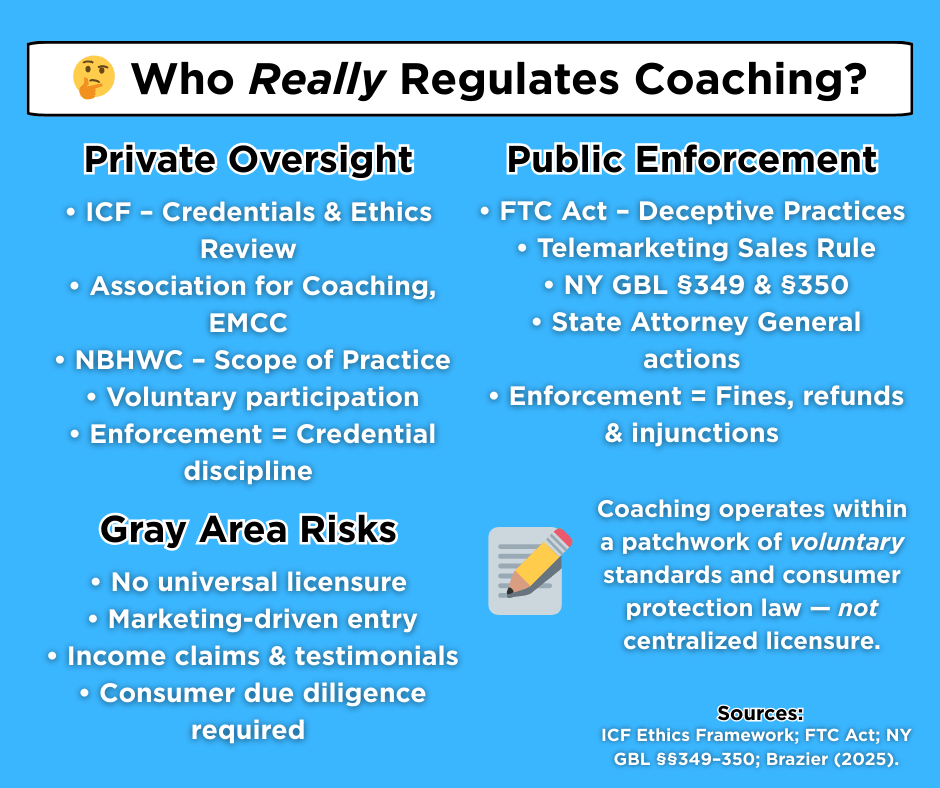
Without centralized licensure, accountability in coaching operates through a patchwork of private ethics frameworks and public enforcement

In my recent capstone investigation, Coaching Industry: Bargain or Scam? – I examined the tension between credibility and skepticism in life coaching. Key interviews with Jenn Drummond, Renee Marino, Michael Anthony and Mike Moosbrugger emphasized ethics, lived experience and client transformation.
However, a central question lingered beneath the surface: who regulates this profession?
Unlike licensed mental health counselors or psychologists, life coaches are not governed by a centralized state licensing board. The industry largely operates under a self-regulated model, with organizations such as the International Coaching Federation (ICF) offering credentialing standards, but not mandatory licensure.
Academic scholarship, including research published in The Coaching Psychologist (2023), notes that inconsistent definitions and supervision standards can produce widely varied outcomes.
Private Oversight: Credentialing Without Licensure
In the absence of government licensing requirements, several professional organizations function as de facto standard-setters within the coaching industry.
The ICF, one of the most widely recognized bodies in the field, offers tiered credentials (ACC, PCC and MCC), requires training hours and documented client experience, and maintains a formal Code of Ethics. The organization also operates an Ethical Conduct Review process, allowing complaints to be reviewed and, where appropriate, disciplinary action taken against members or credential-holders.
Similarly, EMCC Global (European Mentoring & Coaching Council) and the Association for Coaching maintain ethics codes, continuing education expectations and complaints procedures. In more specialized niches, such as health and wellness coaching, the National Board for Health & Wellness Coaching (NBHWC) outlines scope-of-practice guidelines and credentialing standards.
These entities provide structure and professional norms. They can suspend or revoke credentials, or even discipline members.
What they cannot do is prohibit someone from calling themselves a coach. Membership and credentialing are voluntary. A practitioner may operate entirely outside these frameworks and still legally offer coaching services. In that sense, private oversight mechanisms serve as quality-control systems, not regulatory authorities.
For consumers, this creates a layered marketplace. Scholarship in coaching psychology suggests that formal development—such as evidence-based mindfulness training—can elevate practice beyond branding alone. A study in The Coaching Psychologist by Eike Brazier (Apr. 2025, Vol. 20) found that coaches who participated in such a program gained greater self-awareness and improved self-regulation, contributing to stronger presence, clearer emotional boundaries and more reflective decision-making. The study also highlighted self-care and self-compassion as protective factors that can support sustained professionalism over time.
Some coaches operate within credentialed ecosystems tied to ethical review and supervision. Others build brands primarily through digital marketing, testimonials and entrepreneurial positioning. The distinction is not always obvious to prospective clients.
Public Enforcement: When Established Law Steps In
Although coaching itself is generally not licensed as a profession, coaching businesses remain subject to broader consumer protection laws.
At the federal level, the Federal Trade Commission (FTC) Act prohibits unfair or deceptive acts or practices in commerce. This includes false income claims, misleading advertising or deceptive sales tactics. The Telemarketing Sales Rule may also apply in circumstances involving structured sales funnels, prerecorded calls or high-pressure telephone-based selling.
At the state level, similar protections exist. In New York, for example, General Business Law §349 prohibits deceptive acts and practices in the conduct of business, while §350 addresses false advertising. These statutes do not regulate coaching competency; rather, they regulate business conduct.
The distinction matters. The strength of enforcement in coaching does not typically come from a coaching-specific regulator. It comes from established consumer protection law, frameworks designed to address deception, fraud and unfair commercial practices across industries.
A Utah legal analysis notes that life coaching is not a licensed profession, but practitioners risk scrutiny if their services overlap with regulated mental health treatment. Enforcement focuses less on the title “coach” and more on whether services are presented as clinical care. This highlights coaching’s defined, yet unregulated, boundary without centralized statutory oversight.
In other words, public enforcement activates when marketing claims cross legal lines. It does not proactively license or supervise coaches in the way state boards oversee attorneys, financial advisors or therapists.
When Oversight Fails: The FTC Refund Example
Recent federal enforcement actions illustrate how this dynamic plays out.
Federal regulators have previously acted against operators of certain money-making “coaching” or business opportunity programs accused of deceptive earnings claims. In 2024, the FTC announced it was sending more than $2.4 million in refunds to consumers harmed by what it described as a deceptive business coaching scheme (Lurn). According to the agency, marketing materials promised substantial online income that did not materialize for many participants.
These actions did not hinge on whether coaching as a concept is legitimate. They focused on deceptive representations, examples that include promises of guaranteed income, exaggerated success rates or misleading marketing narratives.
The takeaway is not that life coaching as a profession is inherently fraudulent. It is that, in a largely self-regulated environment, legal consequences typically emerge only after consumers report harm and regulators determine that business practices violated established law.
This dynamic echoes concerns raised in my earlier reporting. Michael Anthony, reflecting on his own entrepreneurial journey, described losing at least five figures while working with certain consultants before developing greater discernment. His experience was not framed as systemic fraud, but as a cautionary example of operating in a marketplace where standards and transparency vary widely.
When oversight relies primarily on voluntary credentialing and post-hoc legal enforcement, the burden of evaluation often shifts to the consumer.
The Accountability Gap and What Comes Next
The regulatory landscape surrounding life coaching reveals a structural gray area.
Private organizations provide ethics codes, credential pathways and disciplinary review processes. These frameworks offer professional guidance and signal credibility to informed consumers.
Public law provides enforcement authority when deceptive practices occur. Federal and state agencies can pursue restitution and civil penalties in cases involving misleading marketing or unfair trade practices.
Yet neither system functions as a centralized licensing authority for coaching as a profession.
As digital platforms continue amplifying personal branding and entrepreneurial coaching models, the industry’s growth shows little sign of slowing. The question may not be whether coaching should be licensed like therapy, but whether clearer boundaries, transparent credentialing and stronger consumer literacy can reduce preventable harm.
For now, accountability in coaching operates through a patchwork: voluntary standards on the front end and consumer protection law on the back end. Understanding that distinction may be one of the most important due diligence steps prospective clients can take.
 Who's Next?
Leave a comment