
As coaching expands across nearly every industry, consumers are left to determine what they’re buying – and who is qualified to offer it

A client meets with a life coach to discuss next steps after leaving a corporate role in a shared office space close to Manhattan. The session is structured, scheduled and expectedly costly.
What is being offered is not therapy or formal consulting, but guidance framed as accountability. Also, goal setting and strategic clarity during a period of professional uncertainty.
Encounters like this are increasingly common across industries. Life coaches now position themselves as resources for executives, creatives, entrepreneurs, recent graduates and individuals navigating personal or financial transitions.
Coaching services promise improvement in areas as varied as career direction, productivity, confidence, relationships and decision-making, often without standardized credentials or regulatory oversight. For some clients, coaching provides structure and momentum. For others, it raises questions about value, expertise and boundaries. As the industry expands rapidly, so does the debate over what it actually delivers and whether its breadth is strength or a warning sign.
Scholarship in coaching psychology distinguishes evidence-based coaching from broader motivational or advisory practices by emphasizing practitioner competence, ethical boundaries and clarity of scope. Research published in The Coaching Psychologist (Volume 19, No. 1 – June 2023) notes that when coaching operates without shared professional definitions, supervision or consistent standards, outcomes can vary widely.
This increases the risk of client dissatisfaction or harm, whether intentional or unintentional. This framework, as well as audience or client variance, helps explain why individual experiences with coaching can differ so sharply within an industry that remains largely self-regulated.
Life coaching has grown rapidly over the past decade, fueled by career instability, remote work and a culture increasingly focused on self-improvement and personal optimization. According to the International Coaching Federation, the number of professional coaches worldwide now exceeds 120,000, with industry revenue surpassing $5 billion as demand has expanded across career, leadership and personal development settings.
That flexibility has helped the field expand quickly and unevenly. ICF research shows much of the industry’s recent growth is driven by digitally delivered coaching services, which expand access while lowering barriers to entry. As coaching becomes more visible and more expensive, questions about oversight, qualifications and consumer protection have followed.
What Coaching Is – and Isn’t
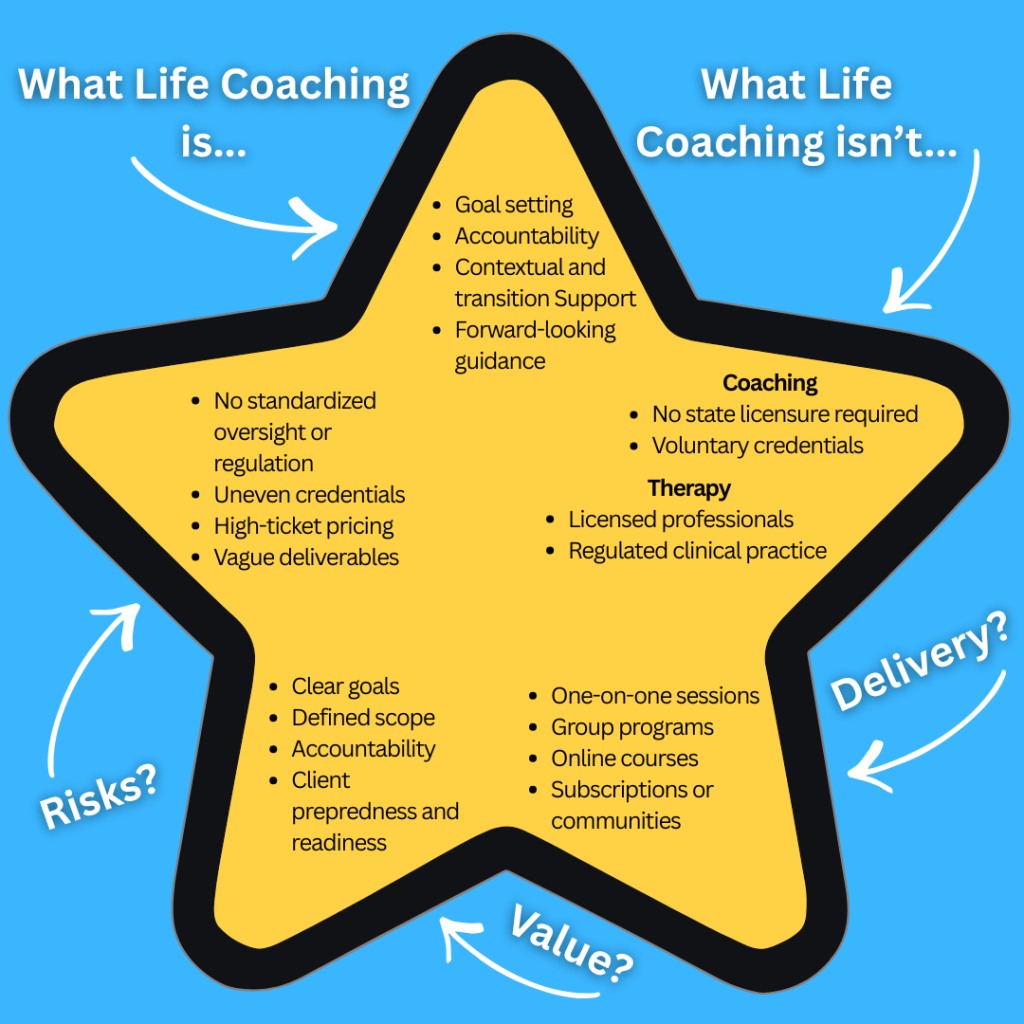
Life coaching is generally described as a goal-oriented practice focused on helping individuals clarify objectives, improve performance and navigate personal or professional transitions. The U.S. Bureau of Labor Statistics defines life coaches as people who assist clients in establishing goals such as changing careers or improving health by offering targeted guidance and motivational support focused on the process of progress rather than clinical diagnosis or therapy.
Unlike clinical therapy, coaching does not diagnose or treat mental health conditions, and practitioners typically position their work as forward-looking rather than therapeutic. Academic and professional definitions often emphasize collaboration, accountability and client-driven outcomes, though there is no single, universally accepted standard.
What life coaching is not is equally important. Coaches are not licensed mental health providers, nor are they legally bound to the same ethical or educational requirements as therapists, counselors or psychologists. As outlined in Fortune’s reporting on the profession, coaching does not require state licensure and operates outside formal medical or clinical regulation.
Vincent Infante, a licensed psychotherapist, said the distinction between coaching and clinical care is critical, particularly when individuals seek support for mental or emotional distress. Unlike life coaches, licensed therapists are trained and authorized to diagnose and treat mental health conditions through structured clinical frameworks and ongoing professional oversight.
“We cannot prescribe medication, and I routinely advise clients to consult their physician or primary care provider,” Infante said.
Coaching also differs from consulting, which typically involves subject-matter expertise and prescriptive solutions within a defined industry or organization. Instead, coaches frequently operate across multiple domains, applying similar frameworks to varied client goals. That ambiguity is felt even among experienced practitioners.
Jenn Drummond, an executive performance coach whose work draws on decision-making frameworks from high-risk environments, said the difference between effective coaching and surface-level motivation often comes down to experience rather than messaging.
“Lived experience has consequences,” Drummond said. “Motivational advice often skips the middle.”
Mike Moosbrugger, a transformation coach who works in mindset and health and has also coached high school football for two decades, said the industry’s breadth can make coaching feel inconsistent from one provider to the next.
“The big secret of coaching is that a lot of us are sharing the same principles,” Moosbrugger said. “The difference is the delivery method, the story behind it, and the personal connection. Not everyone is going to like my style and that’s okay. Figure out whose program resonates with you and go with that person.”
The lack of standardized licensure contributes to ongoing confusion about the profession’s scope and credibility. While some coaches pursue certifications through professional organizations or training programs, these credentials are voluntary and vary widely in rigor. As a result, consumers are often left to interpret qualifications on their own, a dynamic that has shaped both the industry’s growth and the skepticism surrounding it.
Why Demand Is Rising
The rapid expansion of the life coaching industry reflects broader shifts in how people work, identify and plan for the future. Economic volatility, workforce restructuring and burnout have left many professionals navigating career paths that are less linear and less secure than in previous decades.
Research on job satisfaction and employee engagement has increasingly pointed to rising disengagement, particularly among younger and mid-career workers, creating demand for external guidance during periods of transition. Gallup research repeatedly found in 2024 and 2025 that a majority of U.S. employees reported feeling disengaged at work, with burnout and uncertainty about long-term career paths especially pronounced among early- and mid-career professionals.
At the same time, remote work and digital entrepreneurship have weakened traditional sources of mentorship. Without clear organizational ladders or in-house professional development, individuals increasingly seek personalized support outside formal institutions. Coaching services have positioned themselves to fill that gap, offering individualized frameworks for goal setting, productivity and accountability across a wide range of contexts.
Cultural factors also play a role. Social media and personal branding platforms have normalized public self-optimization, while online marketing has made coaching highly visible and easily accessible. Unlike licensed professions, coaching can be packaged, promoted and scaled quickly, often across multiple industries at once. That flexibility fuels growth, but also blurs boundaries between expertise, motivation and marketing – a tension that continues to shape public perception of the field.
Who Becomes a Coach?
There is no single pathway into life coaching, a reality that reflects both the industry’s accessibility and ambiguity. According to Forbes, coaching increasingly attracts freelancers, consultants and mid-career professionals seeking flexible or supplemental work, with many practitioners operating part time or alongside other occupations. This accessibility helps the industry expand quickly while also contributing to wide variation in training, experience and service quality among coaches.
Some practitioners emphasize transferable skills gained in prior roles, such as leadership, communication or mentoring. Others point to personal experiences with coaching or self-development as the catalyst for entering the profession. In interviews, coaches frequently describe motivations rooted in flexibility, income potential or a sense of purpose – narratives that align with broader trends in entrepreneurship and gig-based work.
What distinguishes coaching from many established professions is the absence of standardized experience requirements. While some coaches pursue training or certification through professional organizations, participation is voluntary and credentials vary widely in scope and rigor.
As a result, individuals with vastly different backgrounds and levels of preparation may present themselves under the same professional label. This variability contributes to both the rapid growth of the industry and ongoing questions about consistency, expertise and consumer expectations.
Who Seeks Coaching?
Clients who seek out life coaching often do so during periods of transition rather than crisis. Career changes, financial uncertainty, identity shifts and major life decisions frequently prompt individuals to look for structured support outside traditional institutions.
According to aggregated industry data compiled by ZipDo, a majority of self-improvement participants cite career development, confidence and mental well-being as primary motivations, with many expressing a preference for personalized guidance. Research on adult development and decision-making suggests that moments of transition heighten openness to guidance, particularly when existing support systems feel inadequate.
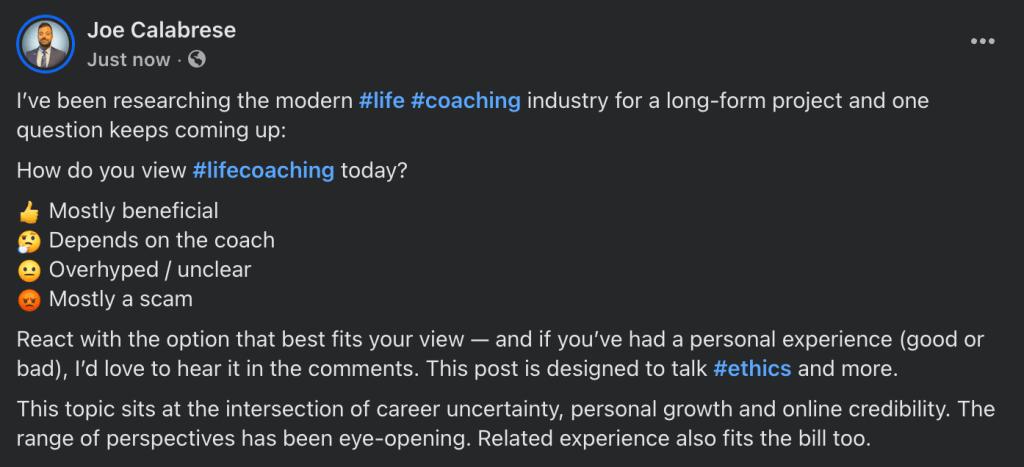
Unlike therapy, which is often associated with mental health treatment, coaching is commonly framed as proactive and future oriented. Clients describe seeking accountability, clarity and momentum, qualities that are difficult to measure but emotionally compelling. In some cases, coaching fulfills practical needs such as goal setting or time management. In others, it addresses fewer tangible desires, including confidence, validation or reassurance during uncertainty.
Expectations vary widely. Some clients report positive outcomes, citing improved focus or follow-through. Others describe mixed or inconclusive results, particularly when goals are poorly defined or when coaching extends beyond its stated scope. Because coaching relationships are typically governed by private contracts rather than standardized oversight, responsibility for evaluating effectiveness often rests with the client. That dynamic complicates assessments of success and contributes to uneven experiences across the industry.Clients who seek out life coaching often do so during periods of transition rather than crisis. Career changes, financial uncertainty, identity shifts and major life decisions frequently prompt individuals to look for structured support outside traditional institutions.
According to aggregated industry data compiled by ZipDo, a majority of self-improvement participants cite career development, confidence and mental well-being as primary motivations, with many expressing a preference for personalized guidance. Research on adult development and decision-making suggests that moments of transition heighten openness to guidance, particularly when existing support systems feel inadequate.
Unlike therapy, which is often associated with mental health treatment, coaching is commonly framed as proactive and future oriented. Clients describe seeking accountability, clarity and momentum, qualities that are difficult to measure but emotionally compelling. In some cases, coaching fulfills practical needs such as goal setting or time management. In others, it addresses fewer tangible desires, including confidence, validation or reassurance during uncertainty.
Expectations vary widely. Some clients report positive outcomes, citing improved focus or follow-through. Others describe mixed or inconclusive results, particularly when goals are poorly defined or when coaching extends beyond its stated scope.
Because coaching relationships are typically governed by private contracts rather than standardized oversight, responsibility for evaluating effectiveness often rests with the client. That dynamic complicates assessments of success and contributes to uneven experiences across the industry.
What Works – and What Doesn’t
Research on coaching outcomes suggests that results are most consistent when the scope of engagement is clearly defined, expectations are aligned and clients enter the process with specific measurable goals. Younger’s reporting in Forbes indicates that studies of executive and workplace coaching associate structured programs emphasizing accountability, feedback and clearly defined objectives with measurable gains in productivity and leadership effectiveness, particularly in professional settings.
Ethical boundaries also play a critical role. Coaches who clearly distinguish their work from therapy or clinical intervention reduce the risk of role confusion and client harm. Transparency around qualifications, pricing and intended outcomes further supports informed decision-making. In interviews, both coaches and clients frequently emphasize readiness and mutual accountability as key factors in successful engagements.
By contrast, problems tend to emerge when coaching relationships are poorly defined or driven by unrealistic promises. According to The New York Times, the life coaching industry’s rapid growth and lack of formal oversight contribute to high-pressure sales practices and costly programs that, in some cases, leave clients facing financial strain when promised outcomes fail to materialize. These dynamics fuel broader concerns about consumer protection and accountability within the field.
Renee Marino, international keynote speaker and communication coach who transitioned careers after a performance background, noted legitimate coaching starts with listening and clear scope.
“True, authentic coaching is about what you can give, not what you can get,” Marino said. “If a coach is telling you what they can do for you before they’ve really listened to who you are and what you need, that’s a red flag. Effective coaching starts with listening to hear, not just to respond.”
Because there is no formal oversight body, mechanisms for accountability remain limited. Disputes are typically resolved through private contracts rather than external review, placing a significant burden on consumers to assess credibility and effectiveness. This uneven landscape helps explain why coaching produces meaningful benefits for some clients while leaving others questioning the value of the investment.
The Business of Coaching
Life coaching operates as a business as much as a service, with revenue models that vary widely in scale and structure. Many coaches offer one-on-one sessions priced by timed consultations, topical service or through multi-session packages. Others supplement individual coaching with group programs, workshops, online courses or subscription-based communities.
These diversified models allow coaches to increase reach and income while reducing reliance on time-bound services. In its reporting on coaching business models, Forbes notes that many coaching businesses rely on a mix of one-on-one services, group programs, digital courses and subscription communities to scale revenue, particularly in online and remote environments.
A prominent feature of the industry is the rise of “high-ticket” programs, which bundle coaching with branding, mindset training or access to peer networks at premium price points. Social media platforms play a central role in marketing these offerings, enabling coaches to build personal brands and attract clients across industries and geographic boundaries. Certification programs and training academies also function as businesses, generating revenue through tuition, continuing education and branded credentials.
The absence of standardized pricing or disclosure requirements makes cost comparisons difficult for consumers. While some clients report clear value from structured programs, others describe confusion about deliverables or return on investment.
Because coaching is often framed as an investment in personal growth rather than a regulated service, financial risk is largely individualized. This commercial flexibility accelerates industry growth while also intensifying scrutiny over transparency, value and consumer protection.
Michael Anthony, known professionally as Michael Unbroken, addressed these concerns from the perspective of a practitioner who has built and scaled multiple coaching businesses while emphasizing service-driven impact.
“Every business I’ve ever built with the foundation of ‘I’m going to go make money’ has failed,” Anthony said. “Every business I’ve built in the name of service to the betterment of people has created real impact – and the money followed.”
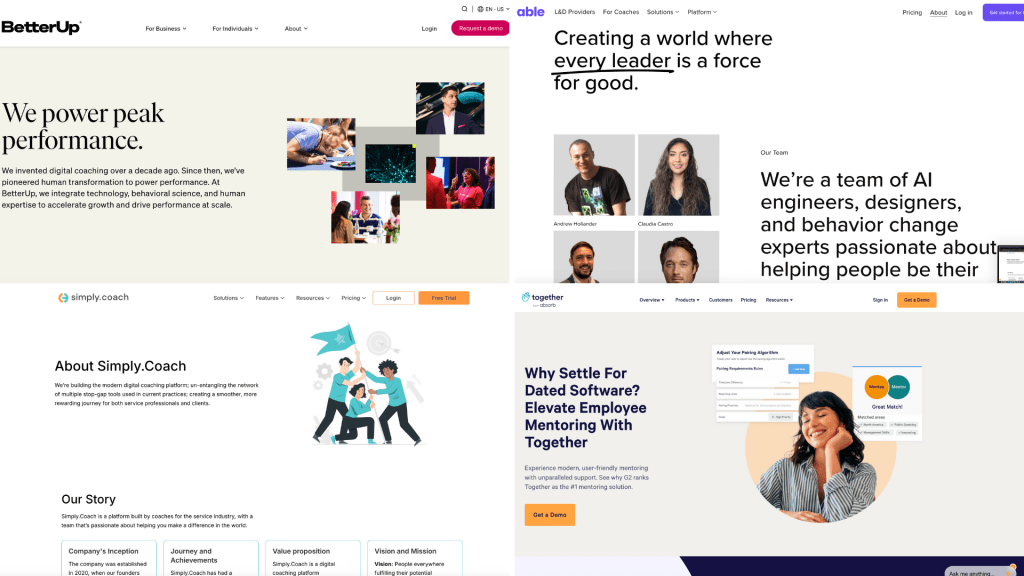
Digital platforms are central in how coaching services are packaged and delivered at scale. Companies such as BetterUp focus on enterprise and individual professional development, while tools like Simply.Coach provide infrastructure that allows independent coaches to manage clients, programs and pricing. Other platforms, including Together, emphasize organizational mentoring and matching systems. Newer digital-first services such as Helloable illustrate how coaching is increasingly delivered online across industries and geographies.
Ethics and Oversight
Ethical questions surrounding life coaching stem largely from the absence of formal oversight. Reporting by Business Insider, citing a ProPublica investigation, found that the industry’s lack of standardized regulation allows some practitioners, including former licensed professionals, to continue offering coaching services without enforceable standards for education, scope of practice or disciplinary review. This regulatory gap places increased responsibility on consumers to evaluate qualifications and risk.
This gap also places significant responsibility on both practitioners and clients. Coaches are expected to set clear boundaries, avoid misrepresentation and refer clients to appropriate professionals when issues exceed the scope of coaching. Clients, in turn, are often responsible for evaluating credentials, understanding contractual terms and assessing risk – tasks that can be challenging in an industry built around personal trust and intangible outcomes.
“The ethical responsibility begins before you work with someone,” Marino said. “I’m very clear that I’m not a doctor and I’m not here to replace a therapist. My role is to be a mirror, but it’s up to the client to take action. That’s why boundaries and expectations have to be clear from the start.”
Calls for greater transparency have increased alongside the industry’s growth. Advocates argue that clearer disclosures around training, experience, pricing and limitations would help consumers make informed decisions without restricting innovation. Whether meaningful accountability can emerge without formal licensure remains an open question – one that continues to shape debates about coaching’s legitimacy and future.
Verdict: Bargain (Service) or Scam?
The client who sits down with a life coach seeking direction is not unusual. Across industries and life stages, individuals continue to turn to coaching in moments of uncertainty, drawn by the promise of clarity and momentum. For some, that promise is fulfilled through clearly defined goals, ethical boundaries and transparent relationships. For others, the experience proves ambiguous or disappointing, shaped by unclear expectations or uneven expertise.
The reporting suggests that life coaching is neither inherently fraudulent nor uniformly effective. Drummond framed the distinction between legitimate coaching and ineffective or misleading practices directly, emphasizing credibility is rooted in accountability rather than aspiration.
“Coaching without lived experience, ethical boundaries, or accountability can absolutely be a scam,” Drummond said. “Inspiration without application is entertainment.”
Instead, it exists within a loosely structured marketplace where outcomes depend heavily on practitioner competence, client readiness and honesty on both sides of the exchange. The same flexibility that allows coaching to adapt across industries also creates conditions for confusion and misuse.
As the industry continues to grow, scrutiny matters. Consumers are increasingly tasked with asking informed questions, while coaches face mounting pressure to articulate limits as clearly as they promote benefits. Whether coaching’s future leans toward greater legitimacy or deeper skepticism may depend less on regulation alone than on transparency, accountability and public understanding.
 Who's Next?
Leave a comment